

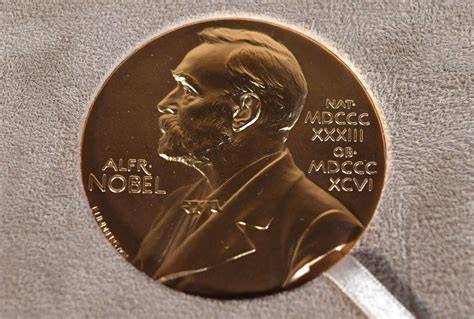
Research in particle physics, astrophysics or the invention of an “invisibility cloak” are some of the achievements that could be honoured when the Nobel physics prize is awarded Tuesday.
The award, to be announced at 11:45 am (0945 GMT) in Stockholm, is the second Nobel of the season, after the Medicine Prize was awarded on Monday to US psychiatrist and neurologist Karl Deisseroth and German scientists Peter Hegemann and Georg Nagel.
The researchers were honoured for their pioneering work in the field of optogenetics, which involves controlling nerve signals with light.
For the physics prize, commentators have for years speculated that metamaterials and Britain’s John B. Pendry, who has become famous for his “invisibility cloak” where light is bent around an object, are due for a nod.
“Since the first breakthrough 20 years ago it has become a large, varied field of research,” Camilla Widebeck, a science producer for public broadcaster Sveriges Radio told AFP, adding that Pendry would likely be honoured alongside American David Smith.
Other commentators have suggested Italian-American Federico Capasso — who is also often cited for contributing to the invention and development of the quantum cascade laser — could also be honoured in the field.
Widebeck also speculated that this year’s prize could build on the 2010 prize, which honoured research into the material graphene — a one-atom thick layer of carbon arranged in a honeycomb pattern.
Spain’s Pablo Jarillo-Herrero together with Canada’s Allan MacDonald and Israel’s Rafi Bistritzer could be honoured for work on twistronics, where two such layers are twisted together — producing superconductivity which has the potential to lead to an energy revolution.
The trio won the 2020 Wolf Prize in Physics, and Widebeck noted Romanian-born US researcher Eva Andrei was also a favourite in the field.
However, she also cautioned that many believed that it “will probably be another few years” before the Nobel committee recognises the work.
– Particle physics –
Research firm Clarivate, which predicts winners of the prize based on the number of citations, spotlighted Japan’s Chihaya Adachi along with Americans Stephen R. Forrest and Mark E. Thompson this year for their work on “ultrahigh-efficiency organic light-emitting diodes” (OLEDs) — used to produce better image quality in screens for smartphones, TVs and computers with lower energy consumption.
Speaking to AFP, David Pendlebury, who heads research analysis at Clarivate, noted that many discoveries can fall into multiple categories and a prize for “OLEDs could be chemistry or it could be physics.”
Clarivate also spotlighted Swiss-British researcher Nicola Spaldin for her theoretical work on “magnetoelectric multiferroics” and China’s Qikun Xue “for experimental observation of the quantum anomalous Hall Effect,” which both have an impact on making products more energy efficient.
Hamish Johnston, online editor of science magazine Physics World, wrote in a blog post that based on recent winners “it appears that both condensed-matter physics, and particle and nuclear physics are due a prize.”
One possibility then is a prize for CERN’s ATHENA and ALPHA collaborations, “who were the first to trap cold antihydrogen atoms and then study them in detail,” which would make Denmark-based American physicist Jeffrey Hangst — a founder of both collaborations — a likely laureate.
The science writer also noted that the jury could honour Belgian physicist Ingrid Daubechies, together with French mathematicians Stephane Mallat and Yves Meyer — a trio which Clarivate spotlighted last year — for something called wavelet theory.
The theory impacts our daily lives through things such as image compression for pictures and videos on computers.
