

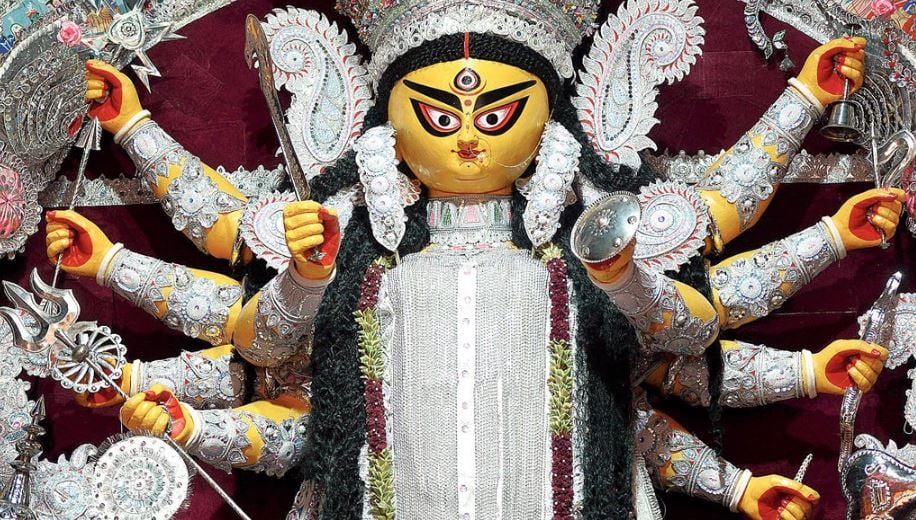
(BSS) – Sharadiya Durga Puja, the biggest religious festival of the Bangalee Hindu community, is knocking at the door, with the festivities set to begin formally in Bangladesh with Maha Shashthi Puja on October 16 this year.
However, Durga Puja did not become the principal festival of Bangalee Hindus overnight. Over several centuries, it evolved from a Hindu religious ritual into one of the most important expressions of Bengali culture, identity, art, community and collective celebration.
Its history is closely linked to Bengal’s social and cultural evolution, the rise of wealthy landowning families, the growth of community-organised pujas and the distinctive Bengali imagination of Goddess Durga—not only as a mighty slayer of evil but also as a daughter returning to her parental home with her children.
UNESCO Recognition: A Global Cultural Milestone
The UNESCO recognition of Durga Puja is a milestone in the festival’s history.
On December 15, 2021, during its 16th session in Paris, the UNESCO Intergovernmental Committee officially inscribed “Durga Puja in Kolkata” on the Representative List of the Intangible Cultural Heritage of Humanity.
The organisation highlighted the festival’s combination of religion, art, craftsmanship, public participation and community collaboration.
This made it the first festival in Asia to receive this specific distinction. This recognition reflected something the festival had long demonstrated: its cultural significance extends well beyond the rituals of worship.
The religious roots: Durga arrives in Bengal
Goddess Durga is worshipped across many parts of India, but Bengal developed a distinctive tradition around her autumnal worship, known as Sharadiya Durga Puja.
The religious foundation of the festival lies in Hindu traditions in which Durga defeats Mahishasura, the buffalo demon, symbolising the triumph of divine power over evil. In Bengal, however, this story acquired an especially intimate, familial meaning.
In the Bengali cultural imagination, Durga is also Uma, the beloved daughter of Himalaya and Menaka, who returns to her parental home for a few days every year. Her children—Lakshmi, Saraswati, Kartik and Ganesh—accompany her in the familiar Bengali representation of the goddess.
This combination of mythology, motherhood, family reunion and homecoming has helped make the festival emotionally meaningful far beyond the formal rituals of worship.
Zamindars made Durga Puja grand
In the late sixteenth and seventeenth centuries, wealthy zamindars and royal families helped establish elaborate autumnal Durga Puja celebrations in Bengal.
One prominent figure associated with the early grandeur of the festival was Raja Kangsa Narayan of Taherpur, in present-day Rajshahi district of Bangladesh. His name is linked to an early grand autumnal puja, although the precise origins of Bengal’s earliest elaborate Durga Puja celebrations remain debated.
