

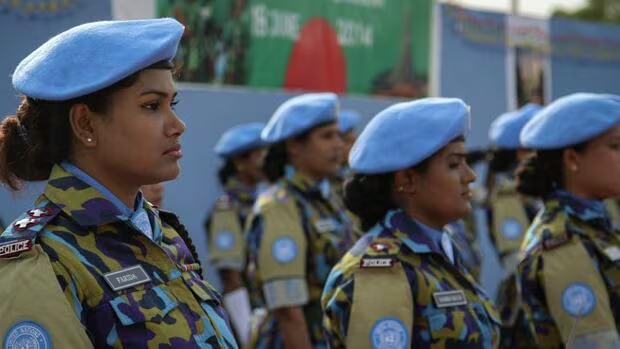
Growing complexities in conflict-affected regions are expanding the roles of Bangladeshi women peacekeepers in United Nations (UN) missions, requiring greater engagement with local communities to address sensitive issues, including conflict-related sexual violence.
Officials familiar with the matter said that, beyond their conventional military and policing duties, women peacekeepers are increasingly playing vital roles in preventing gender-based violence, protecting women and children, providing humanitarian assistance and building trust with local communities.
Changing ground realities have also heightened the need for coordinated efforts by male and female peacekeepers to address complex security and humanitarian challenges in conflict-affected areas, further strengthening Bangladesh’s contribution to global peacekeeping operations.
“The growing complexity of peacekeeping challenges in conflict-affected regions has made the coordinated participation of both women and men increasingly important,” Director of the Inter Services Public Relations (ISPR) Directorate Lieutenant Colonel Sami-Ud-Dowla Chowdhury told BSS.
The Bangladesh Institute of Peace Support Operation Training (BIPSOT) provides specialised training to women peacekeepers, with particular emphasis on gender-related advisory roles, addressing conflict-related sexual violence and ensuring their effective participation in routine peacekeeping operations.
Bangladesh adopted its National Action Plan on Women, Peace and Security in 2019 to promote women’s participation in peace and security initiatives.
An ISPR spokesman told BSS that a total of 2,025 women from Bangladesh’s Armed Forces had participated in UN peacekeeping operations as of September 30, 2026.
Currently, 293 female military personnel are deployed in different UN missions, including 280 from the Army, five from the Navy and eight from the Air Force, he said.
The official added that Bangladesh Police had so far deployed 927 female personnel to UN peacekeeping missions, while four women police officers are currently serving in missions abroad.
According to the Canada-based, UN-hosted Elsie Initiative Fund for Uniformed Women in Peace Operations (EIF), the number of Bangladeshi women peacekeepers serving in UN missions stood at 263 in 2020, rising to 507 in 2022 and 533 in 2023. Their respective participation rates were 4 percent, 7.41 percent and 7.61 percent.
Available statistics show that a total of 2,952 women from Bangladesh’s three armed services and police have participated in UN peacekeeping missions, while 297 are currently serving in different operations.
In a statement marking the International Day of UN Peacekeepers on June 10, 2026, the then Acting UN Resident Coordinator in Bangladesh, Carol Flore-Smereczniak, said Bangladesh had deployed 206,476 personnel to UN peacekeeping operations since 1988. As of mid-2026, a total of 4,212 Bangladeshi peacekeepers were serving in nine missions worldwide.
She said the country’s longstanding contribution reflected its commitment to professionalism, sacrifice, mutual trust and principled multilateralism.
An ISPR report published on December 4, 2017, described the participation of Bangladeshi women peacekeepers in UN missions as a significant milestone.
In 2017, two female pilots of the Bangladesh Air Force – Flight Lieutenant Naima Haque and Flight Lieutenant Tamanna-e-Lutfi – served in the UN peacekeeping mission in the Democratic Republic of the Congo.
Meanwhile, a 160-member all-female Formed Police Unit (FPU) from Bangladesh served in Haiti from 2015 to October 2017, contributing to security operations, community assistance and reconstruction efforts.
According to the Armed Forces Division (AFD), 30 of the 150 Bangladeshi peacekeepers awarded UN medals in Wau, South Sudan, in 2024 were women.
Officials said women peacekeepers play a particularly important role in engaging with local women on sensitive issues, identifying security threats, assisting survivors of violence and building confidence among local communities. In many cases, local women feel more comfortable discussing sensitive matters with female peacekeepers than with their male counterparts.
Under the UN Uniformed Gender Parity Strategy 2018–2028, women accounted for 8.2 percent of military contingent personnel in UN peacekeeping missions at the end of 2024.
The UN aims to increase women’s representation in military contingents to 15 percent by 2028, while setting a target of 25 percent representation among military observers and staff officers.
“Expanding women’s professional skills, leadership opportunities and access to positions of responsibility would further strengthen their contributions to civilian protection and building trust among local communities,” the ISPR director said.
An official concerned said participation in UN peacekeeping missions provides Bangladeshi women with opportunities for professional development, financial benefits, leadership experience and greater recognition on the international stage.
