

Talukder Moniruzzaman
The Sepoy-People’s Revolution of November 7, 1975, in the political history of Bangladesh, was not merely a turning-point event; it marked the beginning of the emergence of nationalist politics opposed to hegemonism in this country. On November 3, 1975, Brigadier Khaled Mosharraf staged a coup. The leaders of this coup, after discussions with the then President Khondaker Mostaq, arranged for 15 military officers involved in the coup of August 15, 1975, to be safely flown to Bangkok.
At this time, Brigadier Khaled Mosharraf himself promoted himself to the rank of Major General and declared himself Army Chief. He placed former Army Chief Ziaur Rahman under house arrest. He removed Khondaker Mostaq from the presidency and installed Chief Justice Sayem as President. Following Khaled Mosharraf’s coup, All India Radio and the Indian media expressed enthusiasm and support for the coup, welcoming it with delight.
On November 4, Khaled Mosharraf’s mother and his brother, accompanied by a small number of pro-Moscow leaders, led a procession from the Dhaka University campus to Sheikh Mujib’s residence in Dhanmondi. Rumours soon spread that the India-Russia axis was behind Khaled Mosharraf’s coup. Anxiety arose in the minds of ordinary people that Bangladesh was once again moving towards the Delhi-Moscow axis. This created an explosive situation in Dhaka.
Meanwhile, the Jatiya Samajtantrik Dal (JSD) and the Communist Party distributed large numbers of leaflets among soldiers in the cantonment. These leaflets described Khaled Mosharraf as a paid agent of the Indian government. The leaflets incited soldiers to revolt against Khaled Mosharraf. JSD had earlier formed cells within the army under the name of the Biplobi Sainik Sangstha (Revolutionary Soldiers’ Organisation).
On the night of November 6, members of this Revolutionary Soldiers’ Organisation revolted against Khaled Mosharraf and his associates. Amid this revolt, when Khaled Mosharraf attempted to flee the cantonment, he was killed. Ziaur Rahman had no involvement in Khaled Mosharraf’s assassination, just as he had no involvement in the coup of August 15.
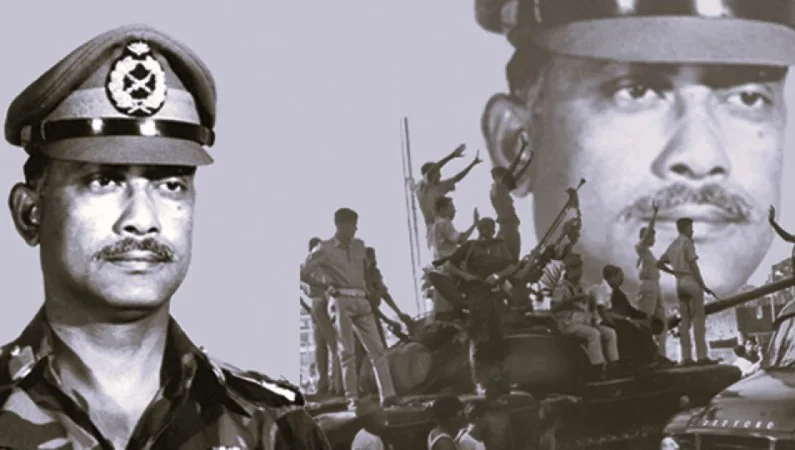
Khaled Mosharraf was killed by soldiers of the JSD-backed Revolutionary Soldiers’ Organisation, while Khaled Mosharraf had arranged for the departure from the country of the military officers involved in the August 15 coup. The rebel soldiers then freed Ziaur Rahman from house arrest. They came out of the cantonment in tanks, trucks and jeeps, creating a festive atmosphere. Ordinary people also joined them. They chanted slogans: ‘Long live Bangladesh’, ‘Long live General Zia’ and ‘Long live the Sepoy-People’s Revolution’.
The jubilant gathering of ordinary people, who mingled with the soldiers on the streets of Dhaka, was viewed as a victory against the conspiracy of Indian hegemonism. On November 7, the revolution took on an organised form. Major General Ziaur Rahman was appointed Army Chief of Bangladesh. Former President Khondaker Mostaq, in a radio address, praised this unprecedented Sepoy-People’s Revolution for safeguarding the country’s sovereignty. He said that Justice Sayem should remain President as a non-political and non-partisan figure.
President Sayem appointed himself Chief Martial Law Administrator and the chiefs of the three services as Deputy Chief Martial Law Administrators. Thus, with the support of ordinary soldiers and the general public, Ziaur Rahman emerged in power. Because of his leadership qualities, he became the centre of power.
Since JSD played a significant role in the Sepoy-People’s Revolution, Zia released imprisoned JSD leaders, including Major Jalil and A S M Abdur Rab. The JSD leaders then began talking about the second phase of their so-called revolution. Their Revolutionary Soldiers’ Organisation presented Zia with a 12-point demand. Among these demands was the restructuring of the existing army to establish a classless army.
They demanded the abolition of the process of appointing army officers and the cessation of the recruitment of army officers from cadet colleges. JSD’s activities and distribution of leaflets within the army in support of these demands created tension. In response, 40 army officers were killed in Dhaka and Rangpur. As a result of such activities by JSD, the army was brought to the brink of destruction. Ziaur Rahman then took several tough measures to restore discipline in the army.
The military’s rise to power following the Sepoy-People’s Uprising was a unique kind of revolution. It is not at all true that General Ziaur Rahman came to power at the barrel of a gun. Ziaur Rahman emerged at the centre of power through the overall support of the army and people from all walks of life.
The character of this revolution was entirely different from military coups in other countries of the Third World. Conspiracy was not the main element of this revolution. Its defining characteristic was the spontaneous support of the army and the people for Ziaur Rahman.
JSD claims that it brought Ziaur Rahman to power and that Ziaur Rahman broke his commitments to them. This claim demonstrates the futility of their so-called theory of armed revolution. For it is rare in history for an armed revolutionary group to take power and then hand it over to someone else.
A revolution requires massive public support. As the Proclaimer of Independence and an unblemished, courageous soldier, Ziaur Rahman enjoyed widespread support from the people and the armed forces. Because of this support, Ziaur Rahman became the hero of the November 7 Revolution, not through the benevolence of JSD.
Through this revolution, not only was the anti-hegemonist sentiment of the people of Bangladesh expressed, but various subsequent steps taken by Ziaur Rahman also restored discipline in the army. The army developed into a professional armed force. The November 7 Revolution not only safeguarded the country’s sovereignty but also gave rise to institutional solidity in the army and an anti-hegemonist consciousness among ordinary people.
