

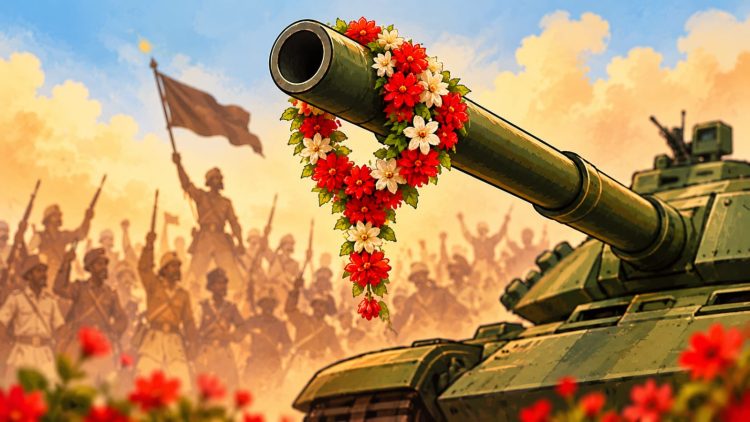
Was there ever a day in the history of Bangladesh when ordinary people lovingly placed floral garlands on the barrels of military tanks? Tanks are weapons of war, yet the people decorated them with flowers! After the Liberation War of 1971, such a scene, almost like something out of a fairy tale, unfolded in the capital, Dhaka, on 7 November 1975. This historic event is known as the ‘Sepoy-People’s Revolution’.
It was a tense period. The country was in turmoil, and people were spending their days in deep anxiety. Then, something extraordinary happened! As the darkness of the night of 6 November gave way to the dawn of 7 November, ordinary soldiers, or sepoys, suddenly began emerging from the Dhaka Cantonment. Even before daybreak, hundreds of thousands of ordinary people took to the streets to welcome them.
There was no violence or fighting that day. There was only an overwhelming love for the country. Ordinary people and sepoys embraced one another and celebrated together. They chanted: ‘Sepoys and people are brothers; there is no alternative to saving the country!’
When their beloved then Chief of Army Staff, Ziaur Rahman, emerged before the people after being freed from confinement, the joy of the crowd knew no bounds. Ordinary people and the country’s soldiers came together as one. As the army’s large tanks rolled through the streets of Dhaka, young boys and men climbed onto them with affection. Garlands of various flowers, including marigolds, were then placed on the barrels of the tanks! In this way, everyone stood shoulder to shoulder in unity in the face of the country’s peril.
The most widely discussed aspects of the 7 November 1975 Sepoy-People’s Revolution were the unprecedented and spontaneous unity between ordinary soldiers of the army and the people, and the release of the then Chief of Army Staff, Major General Ziaur Rahman, who had been under house arrest. Amid the uncertainty prevailing in the country’s political landscape at the time, this was an extraordinary spectacle.
When the sepoys’ uprising began in the cantonment after midnight on 6 November, thousands of ordinary people took to the streets late at night and in the early hours of the morning. Members of the public and armed sepoys embraced one another. One of the most striking and memorable scenes of the revolution was ordinary people placing floral garlands on the barrels of army tanks.
This was a unique expression of the people’s wholehearted support for and affection towards the armed forces. The sepoys freed Chief of Army Staff Ziaur Rahman, who had been placed under house arrest following the 3 November coup, and brought him out like a hero. After his release, the sight of him waving to the assembled soldiers and people was one of the revolution’s most iconic moments.
The streets of Dhaka reverberated that day with slogans such as ‘Nara-e-Takbir’, ‘Allahu Akbar’, ‘Bangladesh Zindabad’, ‘Sepoys and people are brothers’ and ‘Long live Ziaur Rahman’. As a result of the revolution, Khaled Mosharraf’s counter-coup failed and Ziaur Rahman was freed. Through this unforgettable revolution, he was brought to the centre of power.
The most significant aspect of 7 November was how a revolt that began within the military cantonment transformed, within a matter of hours, into a people’s revolution through the spontaneous participation of ordinary citizens, driven by a sense of national identity. In the words of the sepoys, that day was ‘the day of defending the country’s sovereignty’.
The writer is a senior journalist and currently the government’s Chief Information Officer.
(The article was originally written in Bengali and translated into English by Harun Al Nasif, City Editor, BSS.)
