

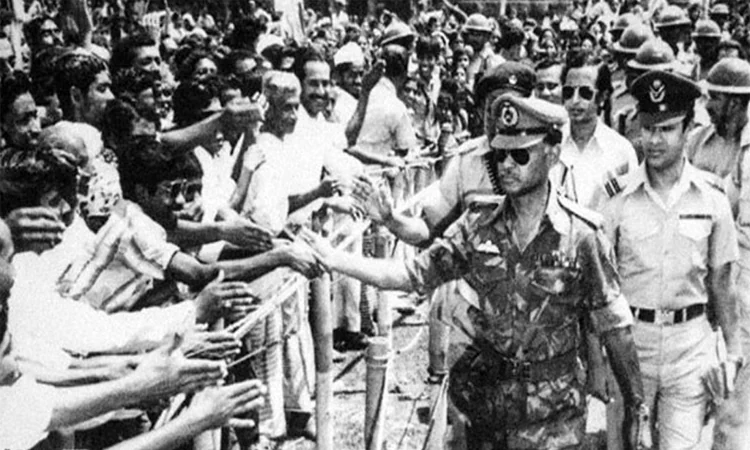
7 November is a significant and eventful day in Bangladesh’s political history. On this day in 1975, at a critical moment of political and military turmoil, the then Army Chief, Major General Ziaur Rahman, was freed from captivity through a combined uprising of ordinary soldiers and ordinary people. In matters of independence, sovereignty and national interest, the events of that day opened an important chapter in the country’s political history. The day came to be known historically as ‘National Revolution and Solidarity Day’.
After the political upheaval of 15 August 1975, the country saw one coup and counter-coup after another. Following the 3 November coup by a section of the army led by Brigadier Khaled Mosharraf, the then Army Chief, Ziaur Rahman, was confined to his residence. For several days afterwards, political and military unrest gripped the country, and ordinary people, too, felt uncertain about the future of the state. In these circumstances, a mutiny began among rank-and-file soldiers during the night of 6 November, continuing into the early hours of 7 November.
A crisis of trust had developed among the ordinary sepoys. They were looking for a popular and acceptable military commander who could restore the army’s chain of command and discipline. The sepoys placed their faith in Ziaur Rahman’s leadership and subsequently freed him from captivity. In the period that followed, he rose to the central position of leadership in running the state.
The significance of 7 November is not confined to the release of one military officer from captivity; rather, the events of that day brought about an important change in the course of Bangladesh’s state and politics. Closely bound up with this historic chapter are the name of Shaheed President Ziaur Rahman, his role in the Liberation War, the various initiatives he took in governing the state, and his contribution to Bangladesh’s political and economic development. In the same continuity, Begum Khaleda Zia’s democratic struggle and the present political reality of Bangladesh under Prime Minister Tarique Rahman’s leadership also carry particular weight in the discussion.
Shaheed President Ziaur Rahman was the proclaimer of independence, a heroic freedom fighter, a military officer and a statesman. After the Pakistani occupation forces began their genocide on 25 March 1971, his declaration of independence, broadcast from the Kalurghat Radio Station in Chittagong, played an important role at the very start of the Liberation War. During the war he served as a sector commander and as commander of Z Force. In recognition of his courage and heroism in the great Liberation War, he was awarded the title ‘Bir Uttam’.
This commander, who had risen from the battlefield of the Liberation War, later took on the responsibility of running the country. War-ravaged Bangladesh was then facing a range of challenges, including economic crisis, food shortages, administrative weakness and political instability stemming from the misrule of the previous government. In this situation, Ziaur Rahman emphasised making the economy production-oriented and involving ordinary people in development activities.
He adopted various programmes aimed at increasing agricultural production, improving irrigation, digging and re-excavating canals, creating rural employment and boosting food output. His 19-point programme gave importance to agriculture, education, health, population control, rural development and economic self-reliance. Through the canal-digging programme, an effort was made not only to bring irrigation water to farmland but also to carry out development work with the participation of rural people.
He also gave importance to industrialisation and the growth of the private sector. His government’s various steps to encourage domestic and foreign investment, widen opportunities for private enterprise, expand export-oriented industries and send workers abroad contributed to the later growth of Bangladesh’s economy. In particular, the initiatives of his period were notable for the early growth of the ready-made garment industry and the expansion of manpower exports to the Middle East and other countries.
Zia’s Role in State Reform and Bangladesh Today
One of the most important chapters of Ziaur Rahman’s political life was the restoration of multiparty politics and the founding of the Bangladesh Nationalist Party (BNP). He founded the BNP on 1 September 1978. Putting Bangladeshi nationalism forward as a political philosophy, he sought to bring people of different political views and traditions together on a single political platform.
His political philosophy placed importance on establishing national unity on the basis of Bangladesh’s own history, language, culture, heritage and geographical identity. Under his leadership, opportunities for multiparty political practice expanded, and various political parties gained the chance to take part openly in politics. New opportunities also opened up for newspaper publication and freedom of expression.
In international relations, too, Ziaur Rahman stressed establishing a distinct position for Bangladesh. He played a role in strengthening relations with the Muslim world, increasing cooperation with China and the Middle Eastern countries, and expanding regional connectivity. His initiative was also important in advancing the idea of cooperation among the countries of South Asia. That idea of regional cooperation from his time later took institutional form with the founding of SAARC in 1985.
After taking on the responsibility of running the state, Ziaur Rahman took various initiatives to build war-ravaged Bangladesh into a self-reliant and prosperous nation. Under his leadership, programmes in agriculture, industry, the economy and rural development began to be implemented.
Because of these initiatives and his leadership qualities, President Ziaur Rahman became established within a short time as a popular and acceptable statesman among the people. In the view of many, domestic and foreign conspirators, alarmed by this popularity, sought to halt his advance and brutally killed him in a military coup at the Chittagong Circuit House on 30 May 1981.
His sudden death plunged the BNP into a deep political and organisational crisis. In those difficult times, his wife, Begum Khaleda Zia, took over the party’s leadership and subsequently, besides organising the party, played an important role in the movement to restore democracy.
Begum Khaleda Zia’s entry into politics was an important event in Bangladesh’s history. She led the movement against military rule and the struggle to restore democracy. Through a long political movement, imprisonment and many adversities, she tried to preserve the party’s organisational unity. When the BNP won the 1991 parliamentary election, she took office as Bangladesh’s first woman Prime Minister. The government under her leadership played an important role in the process of re-establishing parliamentary democracy in the country.
During her government’s time, issues such as women’s education, stipends for girls, expansion of primary education, rural infrastructure development and greater economic participation by women received emphasis. In the years that followed, she continued to play an important role in the country’s politics. In particular, during the long period of political adversity, her stance has been regarded by BNP leaders, activists and supporters as a symbol of the democratic struggle.
On the other hand, after the Awami League government came to power in 2009, the state observance of 7 November as National Revolution and Solidarity Day, along with the public holiday, came to an end. For a long time, the day was confined to the political programmes, discussion meetings and commemorative events of the BNP and its affiliated organisations.
As a result, an important chapter of national history was denied the opportunity for proper discussion at state level. During this period, controversy also arose at various times over the martyred President Ziaur Rahman’s role in the Liberation War, his contribution to running the state and his political philosophy. His contribution was not properly appraised; rather, it was belittled at various times. Yet his contribution to Bangladesh’s political history, his role in the Liberation War and his various initiatives in nation-building are an important part of history.
The mass uprising of students and the people on 5 August 2024 brought about an important change in Bangladesh’s political history. In the new political reality that followed, in 2026 the government led by Prime Minister Tarique Rahman, elected by the direct votes of the people, decided to observe 7 November with state honours as ‘National Revolution and Solidarity Day’. Through a Cabinet decision, the day was restored to the list of nationally significant days, and the public holiday for the occasion was reinstated.
Following the decision to restore the day’s state recognition and public holiday after a long break, 7 November has once again found room for discussion at the national level. This is not merely the revival of a ceremonial day; rather, it has created an opportunity to remember and reassess an important chapter of Bangladesh’s political history in the public sphere.
In continuity with Shaheed President Ziaur Rahman’s nation-building initiatives and Begum Khaleda Zia’s long democratic struggle, a new chapter has begun in Bangladesh’s politics under the leadership of Prime Minister Tarique Rahman. The long rule of the previous Awami League government, marked by corruption, plunder, irregularities and misrule, together with the laundering of vast sums of money abroad, pushed the country’s economy into deep crisis. In this challenging situation, the greatest responsibility now facing Prime Minister Tarique R Rahman’s government is to restore the economy and return it to a stable and dynamic course.
At the same time, it must build a prosperous, self-reliant and non-discriminatory Bangladesh by creating employment, increasing domestic and foreign investment, developing agriculture and industry, improving education and healthcare, and opening up new possibilities for the younger generation.
Alongside this, strengthening democratic institutions, establishing the rule of law, ensuring transparency and accountability in administration, and protecting freedom of expression are also important. The decision to restore 7 November to state honour is a notable step by Prime Minister Tarique Rahman’s government. Through it, the political legacy of the Shaheed President Ziaur Rahman and the historic events of 1975 have come back into national discussion. However, the long-term significance of this initiative will depend on a proper appraisal of history, on democratic practice, and on the continued fulfilment of the people’s expectations.
In conclusion, the events of 7 November form a significant chapter in Bangladesh’s political and national history. Closely bound up with this day are the combined role of soldiers and the people, Ziaur Rahman’s release from captivity, the army’s internal unrest, and the important change this brought about in the country’s politicsorganisationsorganisations
resident Ziaur Rahman’s contribution to the Liberation War, his initiatives in agriculture and rural development, the growth of multiparty politics, and his role in establishing Bangladesh’s international identity are an important part of the country’s history. Likewise, Begum Khaleda Zia’s democratic struggle and the activities of the present government under Prime Minister Tarique Rahman’s leadership are part of Bangladesh’s political continuity.
With 7 November returning to state honour after a long break, an opportunity has arisen to present this chapter of the country’s history to the new generation. Let the significance of this day be to embrace the spirit of independence and sovereignty, to strengthen national unity, and to inspire the establishment of democratic values. Let it be everyone’s hope to learn from the experiences of the past and build a self-reliant, prosperous, democratic and dignified Bangladesh.
Author is Additional Press Secretary to the Prime Minister.
(The article is originally written in Bengali and translated into English by Harun Nasif, City Editor, BSS)
