

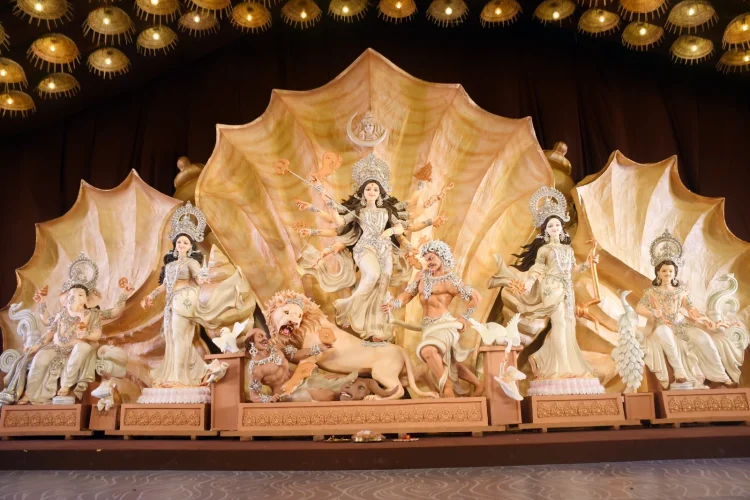
The Hindu community of Bangladesh is celebrating Maha Saptami today, the second day of the six-day Sharodiyo Durgotsab, as the tithi (lunar day) of Maha Saptami spans two days this year.
The extended observance of Maha Saptami will continue tomorrow.
The day began with the Nabapatrika ritual, in which nine plants representing different forms of Goddess Durga are ceremonially bathed and worshipped. Devotees are also offering anjali after the Saptami puja at temples across the country.
Earlier, Maha Shashthi, the first day of Durga Puja, was celebrated on Friday with Bodhan, the ceremonial awakening and invocation of Goddess Durga, marking the formal commencement of the festivities.
Since morning, devotees have been thronging temples and makeshift puja mandaps across the country, with Dhakeshwari National Temple emerging as a focal point of the celebrations in the capital.
Various religious rituals, including Kalparambha and Bihit Puja, were held at the temple in the morning as the six-day festival will continue until October 21.
Mahanagar Sarbajanin Puja Committee General Secretary Suvasish Kumar Biswas Sadhan said the festival began with Maha Shashthi puja, followed by anjali offerings by devotees and distribution of prasad.
Clothes were also distributed among underprivileged people on the occasion.
According to traditional beliefs, Goddess Durga arrives this year on a horse (ghotak), symbolising dry spells, heavy rainfall or an unstable period, and departs on a boat (noka), signifying a bumper harvest and agricultural prosperity.
A total of 33,851 puja mandaps have been set up across the country this year, including 258 in the capital, according to the Bangladesh Puja Udjapan Parishad. The number of mandaps has increased by nearly 1,500 compared with last year.
The Gulshan-Banani Puja Foundation is hosting one of the most elaborate celebrations at Kemal Ataturk Park in Banani, where this year’s theme, ‘Jalaja’, draws inspiration from water as a source of life, creation and divine power.
The mandap features an aquatic-inspired design incorporating traditional crafts, lighting and decorative elements to create an immersive experience for visitors. Pandal hoppers are moving from one venue to another to admire religious art, illuminated displays and creative cultural themes.
Makeshift pandals at Kalabagan ground and Khamarbari have also emerged as major attractions for visitors in the capital. Large temporary mandaps and eye-catching lighting displays are drawing crowds to the venues.
Maha Ashtami will be observed on Monday, with Kumari Puja scheduled at several mandaps. During the ritual, an unmarried pre-pubescent girl, generally aged between one and 16, is worshipped as the living embodiment of the divine feminine and Goddess Durga.
Sandhi Puja will also be held on Monday evening at the transitional moment between Ashtami and Navami. According to Hindu mythology, the ritual commemorates the moment Goddess Durga assumed the form of Chamunda to slay the demon brothers Chanda and Munda.
Devotees will observe Maha Navami on Tuesday with religious fervour and enthusiasm. They will gather at puja mandaps and pandals to offer flowers, water, clothes and ornaments to the deity. The day will feature major concluding worship rituals and the offering of bhog.
On Wednesday, Maha Dashami will be observed, marking the farewell to Goddess Durga. Devotees will take the idols in processions to designated rivers, ponds and other water bodies for immersion, known as Bisarjan.
This year, the government has extended the Durga Puja holiday to three days through an executive order in response to longstanding demands from the Hindu community.
Combined with the regular Friday and Saturday weekend holidays, the extended holiday will provide a five-day break from October 20 to 24.
Bangladesh Puja Udjapan Parishad President Basudeb Dhar thanked Prime Minister Tarique Rahman for extending the holiday on the occasion.
Durga Puja holds deep religious and cultural significance for Bangladesh’s Hindu community. The festival commemorates Goddess Durga’s victory over the demon king Mahishasura and symbolises the triumph of good over evil.
According to Hindu mythology, the deities combined their divine powers to create Goddess Durga, who fought and ultimately defeated Mahishasura.
Beyond its religious significance, Durga Puja is an integral part of Bangladesh’s cultural heritage. The festival brings together members of the Hindu community and people of other faiths, reflecting the country’s tradition of communal harmony and peaceful coexistence.
The government has increased the allocation for Durga Puja mandaps to Tk 5 crore from Tk 4 crore. The rice allocation has also been raised to 600 kilogrammes per mandap from 500 kilogrammes in previous years.
Necessary security measures have been taken nationwide to ensure peaceful and smooth celebrations.
The authorities will use a mobile application previously deployed by the National Telecommunication Monitoring Centre (NTMC) to strengthen monitoring during the festival. The application will facilitate the rapid dissemination of information about any untoward incident and help authorities respond promptly to maintain a peaceful and festive environment.
The Home Ministry has also instructed the relevant authorities to ensure uninterrupted electricity supply to puja venues. Mandap organisers have been asked to keep generators on standby round the clock and maintain rechargeable lights as backup in case of power outages or generator failures.
