

Khulna Correspondent:
Khulna Senior District and Sessions Judge Mr. Chand Mohammad Abdul Alim Al Razi has said that around four million cases are currently pending across the country, making it difficult to resolve the backlog quickly through the conventional judicial system with the existing number of judges.
“There is no alternative to alternative dispute resolution (ADR) to reduce the backlog of cases,” he said.
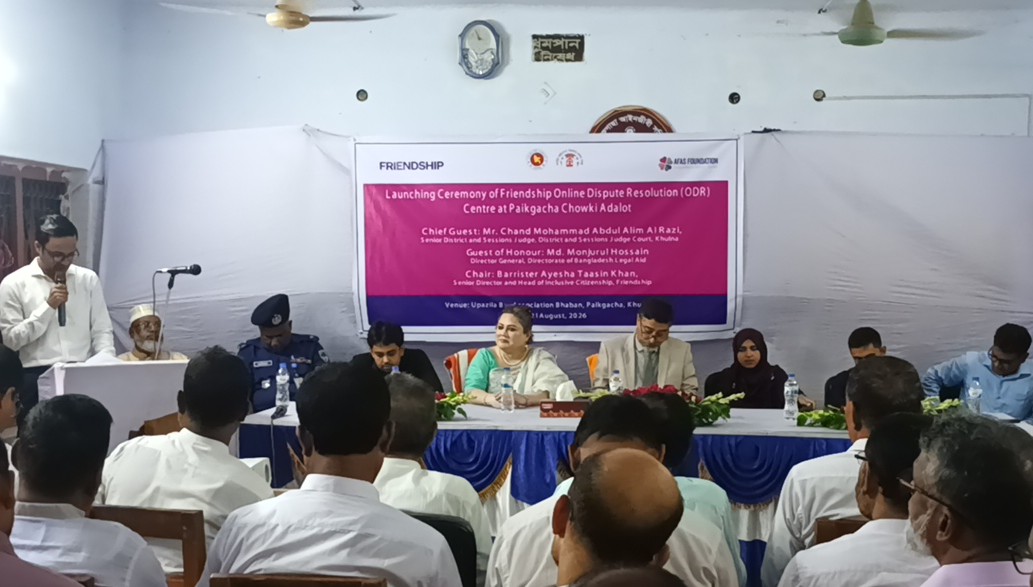
He made the remarks while speaking as the chief guest at the inauguration of the country’s first Online Dispute Resolution (ODR) Center at Paikgachha Chowki Court in Khulna on Friday (August 21).
According to the latest information from the Supreme Court, Judge Al Razi said around four million cases are pending across the country. There are 1,964 judges in the district courts, of whom around 200 are currently serving on deputation. As a result, the number of judges directly engaged in judicial proceedings is even lower, he said.
“It is almost impossible to resolve such a huge number of cases quickly through the conventional legal process with such a limited number of judges,” he added.
The senior district and sessions judge said disputes can be resolved through mediation, ADR or conciliation both before and after filing a case. Provisions for ADR have been incorporated into various laws, including the Code of Civil Procedure, Money Laundering Court, Family Court, Labour Court and Legal Aid Act. In many cases, such settlements have also been made mandatory, he said.
He said that when a dispute is resolved through the traditional court process, one party generally wins while the other loses. Mediation, however, allows both parties to reach a mutually acceptable settlement through compromise.
“This not only provides a lasting solution to disputes but also helps preserve family, neighbourhood and business relationships,” he said.
He further said that after a case is filed, various legal procedures—including appeals to the High Court and Appellate Division and revisions—can take considerable time. Resolving minor and conciliatory disputes through mediation before or after filing a case can therefore reduce the backlog while saving litigants time, money and suffering.
Highlighting the importance of ODR in remote areas such as Paikgachha, Judge Al Razi said it takes around two hours to travel from Khulna city to Paikgachha by road. People from remote areas, including Koyra, face even greater difficulties in travelling to the district town to access legal services.
“Information technology can help bring legal services to people in these remote areas,” he said.
Welcoming Friendship’s initiative, he called for the ODR programme to be expanded to other remote areas of Khulna, including Koyra, so that marginalized communities can access legal assistance and dispute resolution services from their own localities.
Joining the event virtually, Deputy Director (Administration) of the Directorate of Bangladesh Legal Aid, Masuda Yeasmin said ODR is an important and timely initiative for making access to justice easier, faster and more affordable for people living in remote areas.
She said one of the major advantages of online dispute resolution is its ability to reduce geographical barriers.
However, she clarified that ODR is not an alternative to the judicial system. Rather, it is a complementary tool that can make the existing legal aid and mediation system more effective and people-centred.
Speaking as the chair of the event, Ayesha Taasin Khan, Senior Director and Head of Inclusive Citizenship at Friendship, said many people in marginalized areas such as Paikgachha remain deprived of necessary legal aid and dispute resolution services due to geographical distance, travel costs and financial constraints.
“The main objective of Friendship’s ODR Center is to reduce these barriers through technology and bring justice closer to people’s doorsteps,” she said.
She said the center, launched on a pilot basis, will provide people living in marginalized and climate-vulnerable communities with access to legal advice and appropriate dispute resolution services from their own localities.
Mst. Romana Afroz, Khulna District Legal Aid Officer, was present as a special guest.
The activities of Friendship’s ODR Center were presented by the organization’s Assistant General Manager-Legal of Inclusive Citizenship, Advocate Ashiquzzaman.
Among others, Mr. Masum Billah, Judicial Magistrate of Paikgacha Court, Mr. Hazrat Ali, Civil Judge, Upazila Nirbahi Officer Wasiuzzaman Chowdhury, Paikgachha Lawyers Association President Advocate GM Abdus Sattar and other officials and stakeholders were present.
The ODR Center was established under the initiative of Friendship’s Inclusive Citizenship programme in collaboration with the Directorate of Bangladesh Legal Aid.
Through the center, parties involved in eligible disputes will be able to participate in virtual mediation sessions using a designated digital platform.
The initiative is expected to reduce the need for people from remote areas to repeatedly travel to the district town to resolve disputes, saving them time, money and effort while creating greater opportunities for faster and easier access to justice.
