

By Staff Corres[pondent :
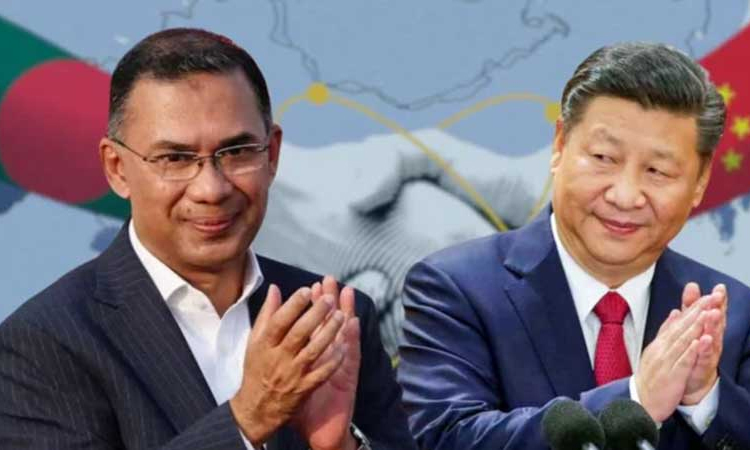
Prime Minister Tarique Rahman is going to China tonight on an official visit amid growing expectations of expanding long-standing economic and development cooperation between the two friendly countries.
The visit has raised hopes and optimism among government and business circles for enhanced cooperation in trade, investment, technology and infrastructure development.
Stakeholders believe the visit would create new opportunities to further strengthen bilateral relations in trade, infrastructure, industrialization, energy, the digital economy and technology sectors.
Bangladesh and China are already deeply engaged in infrastructure development and manufacturing cooperation.
The prime minister left for Malaysia on Sunday on a two-day visit, his first bilateral trip abroad since assuming office. Concluding his visit to Malaysia, he is scheduled to depart Kuala Lumpur tonight for the Chinese port city of Dalian.
Foreign Secretary Asad Alam Siam revealed that the Prime Minister would hold bilateral meetings with China’s top leadership during the visit where discussions will focus on trade, investment, development cooperation, infrastructure, energy security, the digital economy and regional connectivity.
Referring to the priorities of the talks, he said, “Expansion of Chinese investment, accelerated implementation of ongoing projects and measures to narrow Bangladesh’s trade gap with China would receive priority in the discussions.”
The foreign secretary also said that 15 to 17 memorandums of understanding (MoUs), agreements, action plans and protocols are likely to be signed between Bangladesh and China during the visit.
The prime minister is expected to participate in the Annual Meeting of the New Champions of the World Economic Forum (WEF), popularly known as the “Summer Davos,” where he will deliver a keynote speech at a session titled “Climate Leadership in a Shifting Global Landscape.”
He is also scheduled to meet WEF President and heads of government from different countries.
Later in Beijing, he will hold meetings with leaders of the Communist Party of China, officials of the Exim Bank of China and representatives of other key institutions.
On June 25, he will deliver a keynote address at the Bangladesh Investment Forum, organised by the Bangladesh Investment Development Authority (BIDA), highlighting Bangladesh’s investment potential.
Expressing optimism over the visit, Bangladesh-China Chamber of Commerce and Industry (BCCCI) President Md Khorshed Alam told BSS that the Prime Minister’s China visit could add a new dimension to bilateral economic relations.
“Although Chinese investors have long shown interest in Bangladesh’s industrial, energy, technology and agricultural sectors, investment has not yet reached the desired level. If China’s long-term capital market strength and investment capacity could be utilized in Bangladesh in line with global investment trends, the country’s capital market could become deeper and more stable,” he said.
He further noted that increased technology transfer and industrial cooperation would also significantly boost production capacity.
“Attracting greater Chinese investment would require clear policies, swift implementation of decisions and ensured energy and infrastructure support,” he said.
Yousef Xu, Executive Director for South Asia at Chinese infrastructure company CCECC, told BSS that Chinese businesses are keen to invest in Bangladesh. “The high-level visit would further strengthen diplomatic relations and play an important role in expanding trade and investment.”
He added that Chinese business representatives would participate in the “Bangladesh Investment Forum” organized by BIDA during the prime minister’s visit and gain firsthand insights into Bangladesh’s investment opportunities.
Business leaders believe that future progress in Bangladesh-China economic relations will depend on three key factors— investment implementation, export diversification and technology transfer. Effective progress in these areas could take the economic partnership between the two countries to a higher level.
According to sources at the Ministry of Commerce, Bangladesh-China trade currently stands at between US$22 billion and US$25 billion. However, as the trade structure remains largely import-driven, Bangladesh’s export share is comparatively low.
Business leaders said there is significant scope to narrow the trade gap by increasing exports of readymade garments, leather goods, agricultural products, light engineering items and processed food.
They also noted that greater technology transfer, infrastructure development and fresh investment could significantly boost Bangladesh’s industrial output and export capacity.
