


Staff Correspondent :
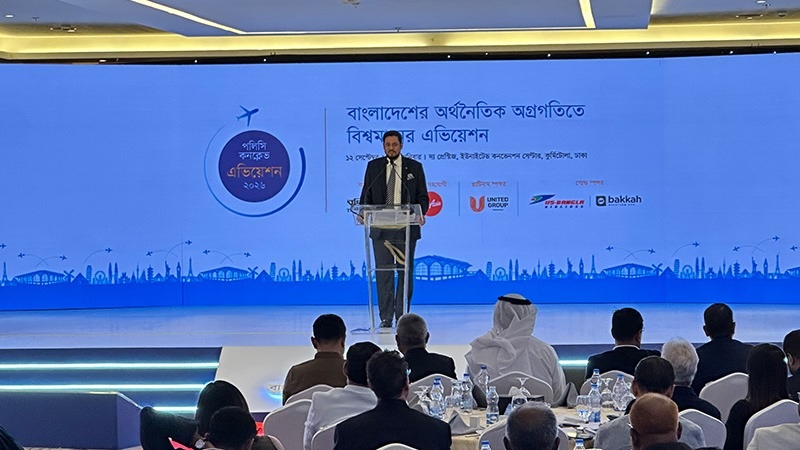
Bangladesh’s aviation industry must undergo sustained development and modernisation to support the country’s ambition of becoming a US$1 trillion economy by 2034, speakers and industry stakeholders said at Policy Conclave Aviation 2026.


The policy conclave, organised by The Daily Bonik Barta under the theme “World-Class Aviation for Bangladesh’s Economic Development,” brought together policymakers, aviation professionals, diplomats, investors, business leaders and other stakeholders to examine the sector’s potential, challenges, investment opportunities and policy priorities.
According to the event brief, Bangladesh’s aviation industry employs more than 475,000 people and contributes about US$5.3 billion annually to the country’s GDP, equivalent to around 1.2 percent of the economy. More than 12 million international passengers use Bangladesh’s air transport system each year, highlighting the sector’s growing economic and strategic importance.

The brief also projects that Bangladesh’s air transport market could expand by 160 percent over the next decade, potentially adding roughly US$2.1 billion a year to the economy. Stakeholders therefore stressed that aviation should be treated as a critical component of national economic planning rather than solely as a transport service.
Despite its potential, the sector faces structural constraints. The discussions highlighted the need to modernise airport infrastructure, expand passenger and cargo-handling capacity, strengthen regional and international connectivity, improve the safety and efficiency of flight operations, and introduce technology-driven services across civil aviation.
Building a sustainable aviation industry capable of competing globally was identified as another important priority. Participants emphasised that improved connectivity and efficient aviation services can support international trade, tourism, foreign investment and Bangladesh’s integration with global transport networks.
The government has already taken steps to increase budgetary support for aviation. The event brief specifically points to a focus on developing the airports in Chattogram, Sylhet, Rajshahi and Cox’s Bazar into international gateways and integrated logistics hubs. Such development could strengthen regional connectivity while expanding the country’s capacity to handle passengers and air cargo.
Speakers also underscored the importance of creating a policy and investment environment capable of attracting greater private-sector participation. Long-term planning, infrastructure investment and stronger coordination among government agencies and industry stakeholders were identified as essential to unlocking the sector’s full potential.
Technology and digital transformation are expected to play an increasingly important role. From airport operations and cargo management to passenger services and airline processes, technology-driven systems can improve efficiency, safety and customer experience while helping Bangladesh move closer to international standards.
AirAsia Airlines – A GSA of TAS Group Ltd served as the Lead Sponsor of the conclave. Its participation came as the event placed particular emphasis on connectivity, market development and the role of international aviation operators in strengthening Bangladesh’s links with regional and global destinations.
The event brief said Rasheduzzaman Mital, MP, Minister for Civil Aviation and Tourism, was scheduled to attend as Chief Guest, while Humaiun Kobir, State Minister for Foreign Affairs, was scheduled to attend as Special Guest. Air Vice Marshal Md Mostafa Mahmood Siddiq, Chairman of the Civil Aviation Authority of Bangladesh (CAAB), was scheduled to attend as Guest of Honour. Air Vice Marshal (retd) Mahmud Hussain, former chairman of CAAB, was scheduled to deliver the keynote address on “World-Class Aviation for Bangladesh’s Economic Development.”
The conclave ultimately provided a platform for stakeholders from domestic and international organisations to exchange views on how Bangladesh can build a more resilient, efficient and globally competitive aviation ecosystem. The consensus was that a stronger aviation sector can become an important engine of economic growth, helping Bangladesh expand trade, tourism, investment and international connectivity in the years ahead.


