


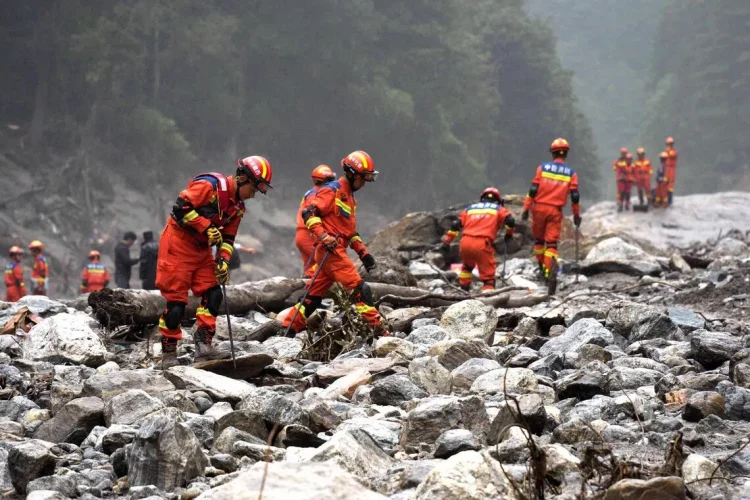
(BSS/AFP) – Nepal was burying on Monday some of the hundreds of bodies retrieved after a deadly, tsunami-like flood crashed through the Himalayan region, sweeping away villages and leaving thousands still missing.
Distraught families have packed rescue stations and hospitals in search of their missing relatives, while others have faced the grim task of identifying bodies at overflowing morgues.
The huge wave of ice, rocks and debris that smashed into villages and towns on Wednesday claimed at least 797 lives in both Nepal and Tibet — across the border in China — with reports of some bodies possibly swept downstream as far as India.
At least 3,048 people remain missing, including many tourists and pilgrims to Tibet’s sacred Mount Kailash. There are also 933 workers at hydropower plants among those unaccounted for in Nepal.
Nepali army troops and engineers drilled through debris on Sunday towards workers believed trapped in a tunnel at the Trishuli 3A hydroelectric site in the Himalayan river valley after they successfully inserted a pipe into the passage.
Workers who managed to get out described horrifying scenes when the disaster struck.
Surendra Dowluri, 33, from India’s Andhra Pradesh state, said raging water swamped the Upper Trishuli-1 site, where he was working.
“We heard a very loud sound… and saw that the turbine floor was submerged with slush, and six workers were stuck in that,” Dowluri told AFP in the Nepali capital Kathmandu after his rescue four days into the disaster.
“We managed to rescue five of them, but one person lost his life,” he said, describing how some workers reached higher ground or construction areas out of reach of the torrent.
Overnight rain and rising river waters also hampered rescue operations on Sunday, filling the excavation area with water before conditions eased, the Nepali army said.
– DNA samples –
The disaster was caused by a glacial collapse, sending a wall of water and debris downstream, the US Geological Survey said.
The torrent caused the formation of huge lakes, closely watched by emergency workers for risks to their operations.
Chinese rescuers near the Tibet border port that was hit by a deadly mudslide were “moved to a safe location” on Sunday after a new lake was formed by a landslide, state media reported.
China has so far put the death toll in Tibet at 16, with the number of missing at 546.
In Nepal, the disaster agency raised the total number of people missing on its side of the border to 2,502 on Sunday, saying there were also 781 confirmed deaths.
Overwhelmed by the number of bodies and without proper freezing facilities, Nepali authorities have had to begin burials before completing the identification process.
Officials said DNA samples were taken from the bodies so that families could later claim them and perform traditional funeral rites.
Grieving relatives gathered at identification centres to watch LED screens showing pictures of retrieved bodies, occasionally closing their eyes when the grim exercise overwhelmed them.
Walking out from one such building next to a makeshift morgue, Shobha Adhikary told a local coordinator she believed one image showed her childhood best friend.
“It looks like him, for sure,” she said, showing coordinators a photograph of a smiling, middle-aged man.
“My husband and I are best friends with Rajkumar and his wife Geeta,” she said. Geeta has also been missing since Wednesday.
– ‘Swept away’ –
Survivors were also faced with the daunting prospect of rebuilding their lives from nothing.
“All the settlements near the river were swept away,” resident Buddhi Ram Dangol told AFP in Nepal’s Nuwakot district.
“There is nothing left.”
The United States and Canada said they would provide $3.6 million each in humanitarian aid to Nepal.
The UK has offered $6.8 million, while the UN released $2.5 million in emergency funding, and aid pledges were made by the European Union, the International Federation of Red Cross and Red Crescent Societies, and others.
Nepal’s economy is already under pressure, with limited resources to respond to a disaster of this scale. Foreign Minister Shisir Khanal said the reconstruction bill could run into “billions of dollars”.
He appealed for specialised assistance, including heavy-lift drones and technology to help locate people who are trapped.
Khanal also called for forensic testing kits to identify corpses and freezer units to store them, saying bodies that have been in water could decompose at a faster rate.
The minister has highlighted the inequity that Nepal should suffer the extreme impacts of climate change when it has one of the world’s lowest per-capita carbon emissions.
That is due to its location in the Himalayas, the world’s highest mountain range, where glaciers are melting at rapid speed as the planet heats.
In Tibet, which is largely inaccessible to foreign journalists and where Chinese authorities are the only source of information, a total of 2,141 personnel have joined search and rescue operations.
In an illustration of the difficulties of access, Chinese rescuers seeking to establish a route to the Tibet epicentre of the disaster, Gyirong Port, only advanced 285 metres (935 feet) on Sunday.
They have another 1.25 kilometres to go before reaching the site, the state-run Xinhua news agency reported.


