


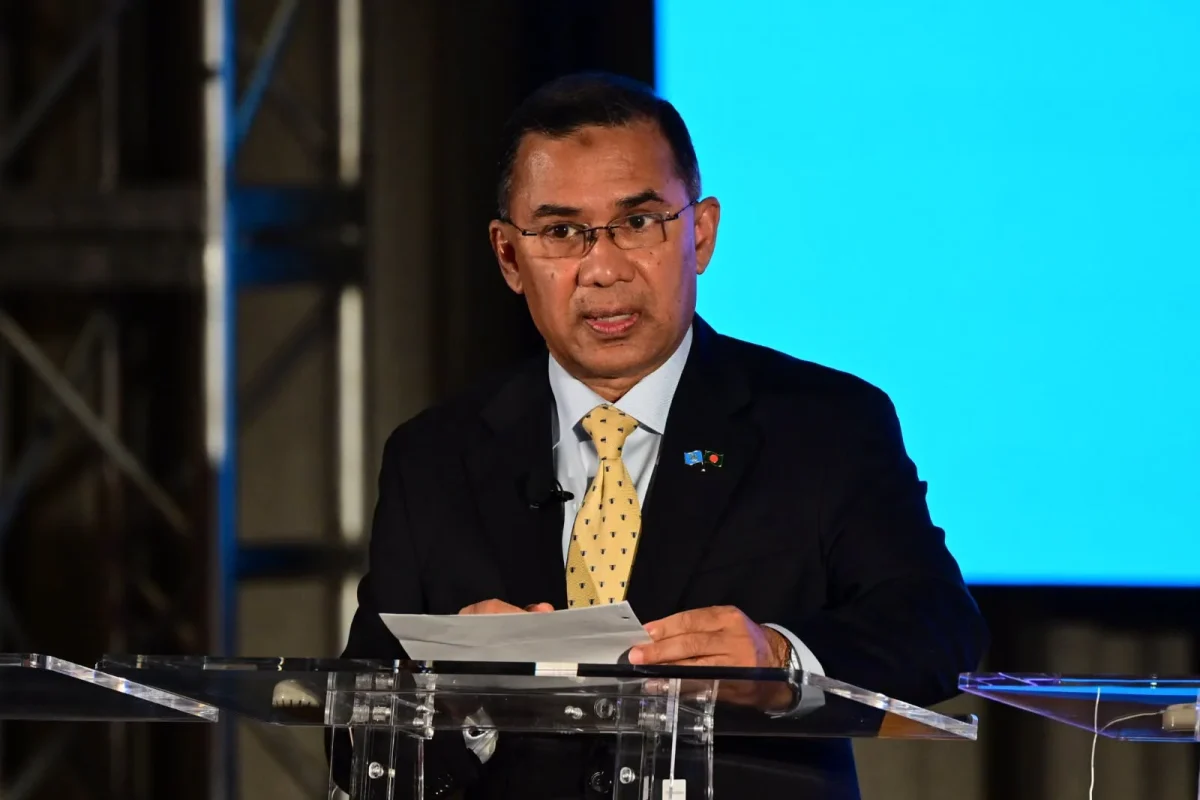
Prime Minister Tarique Rahman today called for collective global actions to build a safer and more sustainable future for the next generation, urging the international community to take five urgent measures, including cutting greenhouse gas emissions and ensuring predictable climate finance for climate-vulnerable countries.
“Let us act together to build a safer and more sustainable future for generations to come,” the prime minister said while addressing a high-level meeting on “Climate Action and the Just Transition” at the United Nations Headquarters here.
The meeting was held this afternoon (local time) at the Trusteeship Council Chamber of the UN Headquarters, convened by UN Secretary-General António Guterres as part of the high-level week of the 81st session of the United Nations General Assembly (UNGA).
The high-level meeting discussed strengthening international cooperation to address the impacts of climate change, ensure climate justice and accelerate a sustainable and just energy transition.
In his address, the prime minister outlined five urgent measures for global climate action—reducing greenhouse gas emissions to maintain the 1.5 degrees Celsius limit under the Paris Agreement, ensuring predictable and accessible adaptation finance for climate-vulnerable countries, expanding access to climate-smart technologies, scaling up renewable energy through finance and technology transfer, and fully implementing and regularly replenishing the Loss and Damage Fund.
Highlighting Bangladesh’s vulnerability despite its negligible contribution to global emissions, Tarique Rahman said the country accounts for less than 0.5 percent of global greenhouse gas emissions, yet remains one of the most climate-vulnerable nations.
“By the end of this century, 12 to 18 percent of our coastal areas could be submerged by sea-level rise, affecting the livelihoods of tens of millions,” he said.
The prime minister said climate change has already caused loss and damage equivalent to one percent of Bangladesh’s GDP, while the country’s food security is also facing serious risks.
“Yet, without international support, we risk severe damage,” he said, referring to Bangladesh’s climate adaptation efforts.
Tarique Rahman said Bangladesh has allocated nearly US$3.19 billion in the current budget for climate adaptation and is undertaking various measures to strengthen resilience against climate impacts.
“We plan to plant 250 million trees over five years,” he said, adding that Bangladesh is also digging around 20,000 kilometres of rivers and canals alongside implementing the Padma Barrage and Teesta Barrage Master Plan.
These initiatives, he said, aim to retain water, reduce flood risks, revive wetlands and recharge groundwater.
On Bangladesh’s transition towards clean energy, the prime minister said the country aims to generate 20 percent of its electricity demand from renewable sources by 2030.
“We are promoting green industries, including jute products, eco-friendly transport, waste-to-energy and circular economy initiatives, while developing a national carbon market,” he said.
Calling for stronger international partnership, the prime minister said Bangladesh cannot achieve its climate goals in isolation.
“Collective action based on ‘Common but Differentiated Responsibilities and Respective Capabilities’ is imperative,” he said, adding, “Bangladesh seeks partnerships that help us implement our plans.”
Outlining the five urgent measures, Tarique Rahman called for global emission reductions to achieve the 1.5 degrees Celsius warming limit set out in the Paris Agreement.
He stressed the need to ensure predictable and accessible finance for adaptation in climate-vulnerable countries, saying greater access to climate-smart technologies is necessary to make a just and equitable climate transition possible.
The meeting was attended by heads of state and government, representatives of international organisations, multilateral development banks, businesses and civil society.


