


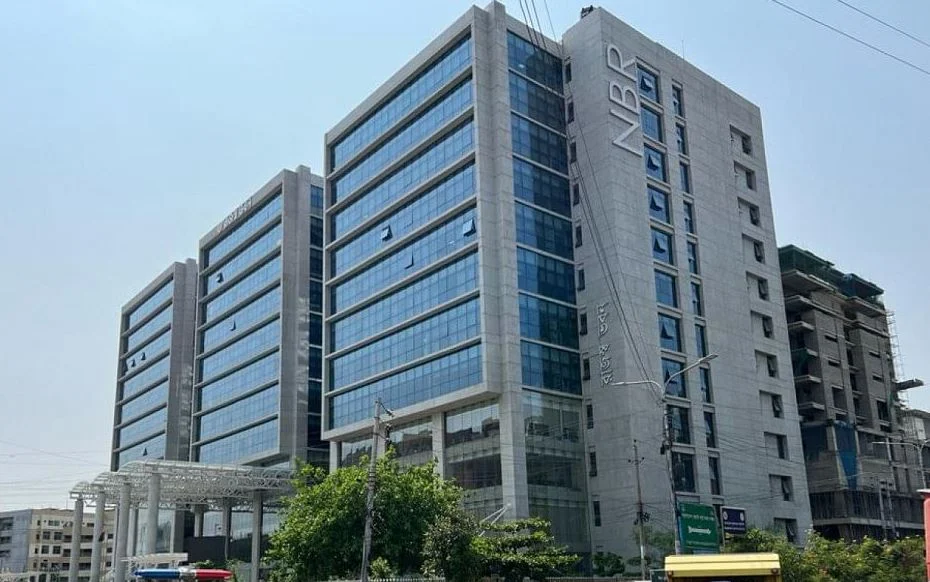
National Board of Revenue (NBR) has outlined a comprehensive reform and capacity-building roadmap to raise Bangladesh’s tax-to-GDP ratio from the current 6.8 percent to 15 percent by 2035 through pursuing the “One NBR” architecture focusing on widening the tax base, strengthening compliance, improving digital systems and integrating tax administration.
To attain this goal, the income tax, customs and VAT wing will work in an integrated manner like “One NBR” architecture to attain this desired goal.
The revenue authority presented the roadmap at the second meeting of the Parliamentary Standing Committee on the Ministry of Finance last month, highlighting the need to improve revenue productivity to keep pace with the expansion of government expenditure.
The NBR made detailed presentations on its capacity to meet government expenditure requirements, measures taken to narrow the tax-to-GDP gap, and assessment of the NBR’s organisational structure and necessary measures.
The NBR said achieving the FY2026-27 revenue target and raising the tax-GDP ratio cannot rely solely on higher tax rates. It requires a major expansion of the tax base, technology, data use and taxpayer compliance.
It proposed an integrated “One NBR” architecture, bringing income tax, VAT and customs administrations into a more integrated taxpayer-management system.
The NBR has outlined a roadmap to increase the tax-to-GDP ratio from the current 6.8 percent to 15 percent by 2035.
The roadmap sets an interim target of 8.8 percent in the short term, followed by further improvement of 10 percent in the medium term before reaching 15 percent by 2035.
The presentation identified investment in revenue administration, skills development, system interoperability, risk management and taxpayer services as key drivers of revenue growth.
The NBR currently accounts for around 86 percent of the government’s total revenue, according to the presentation.
Talking to BSS, a senior NBR official said the revenue board is strengthening its institutional and operational capacity which has now become a state priority, particularly as Bangladesh seeks to increase domestic revenue mobilisation while supporting economic growth.
According to NBR data, the country’s tax-to-GDP ratio has remained mostly between 7 and 8 percent over the past 25 years. It reached around 10 percent during FY2011-12 to FY2014-15 before declining again, standing at 6.7 percent in FY2024-25 and 6.8 percent in FY2025-26.
The NBR said the current ratio remains among the lowest compared with South Asian and neighbouring countries, while the long-term target has been set at 15 percent by 2035.
The presentation said the NBR has analysed 25 years of data covering the size of GDP, government budget, revenue and development expenditure, NBR revenue collection and growth, government borrowing and tax-to-GDP trends in neighbouring countries to establish benchmarks and identify areas requiring reform.
It also compared government expenditure with NBR revenue collection and found that government expenditure increased 4.47 times over the last one era under review, against a 3.40-fold increase in NBR revenue collection. The NBR therefore stressed the need to increase revenue productivity in line with the growth of public expenditure.
The presentation showed that average revenue growth from FY2001-02 to FY2025-26 stood at 13.43 percent, while the NBR projected that achieving the FY2026-27 revenue target would require substantially higher growth compared with the actual collection in FY2025-26.
The NBR identified several immediate areas for strengthening revenue administration, including taxpayer services, governance, policy capacity, data management, information technology and human resources.
Under its proposed action plan, the NBR plans to review the legal framework and transition arrangements, establish a comprehensive enterprise architecture, create a unique taxpayer master database and develop a common data dictionary and system inventory.
The NBR also proposed establishing a Revenue Policy Secretariat, developing a tax-expenditure register and introducing mandatory policy-costing templates.
In the first three years, the NBR plans to introduce a unified taxpayer account, integrated customer relationship and case-management systems, third-party data matching, a cross-tax compliance risk engine and a common payment and arrears view.
For customs, the NBR proposes retaining specialised border functions while integrating importer and exporter identities with valuation, VAT and income-tax risk data.
Over three to five years, the NBR aims to develop near-real-time compliance analytics, expand pre-filled tax returns where legally feasible, automate low-risk refunds and introduce advanced entity-network and fraud analytics.
It said its revenue policy also seeks to support industrial development and export competitiveness through reduced duties on raw materials and capital machinery, VAT exemptions for agriculture, essential commodities and ICT, sector-based reduced income-tax rates and exemptions, customs automation and single-window services.
The revenue board listed agriculture, garments, refrigerators and air-conditioners, information technology, automobiles and electric vehicles, mobile phones, SMEs and the capital market, healthcare and education, pharmaceuticals and renewable energy among the sectors receiving various fiscal and customs policy support.


